
AI in Manufacturing

Every manufacturer is being asked the same question right now: what are we doing with AI? Boards want a plan. Plant leaders want machines that don’t go down. Somewhere between the boardroom mandate and the plant floor reality, a lot of AI initiatives stall out.

Most manufacturers are running pilots, testing use cases, or actively evaluating industrial AI vendors. Far fewer describe themselves as fully prepared to scale AI beyond a pilot. That gap isn’t really about the technology; the models keep getting more capable. The gap is operational. Manufacturers are discovering that a working AI pilot and a production AI capability are two different projects. The pilot proves the concept. Scaling it requires clean, connected data, a workflow it actually plugs into, and people who trust and use what it recommends.

The industry is also shifting focus. Much of the first wave of manufacturing AI was generative; summarizing, drafting, answering questions. The next wave is agentic: systems that take a recommendation and act on it or coordinate a multi-step task with limited human input. That raises the stakes on getting the fundamentals right, because a system acting on bad data does more damage, faster, than a dashboard just showing bad data.

Email info@grantek.com or call 866.936.9509 to learn how your operations can benefit from Grantek’s experience.
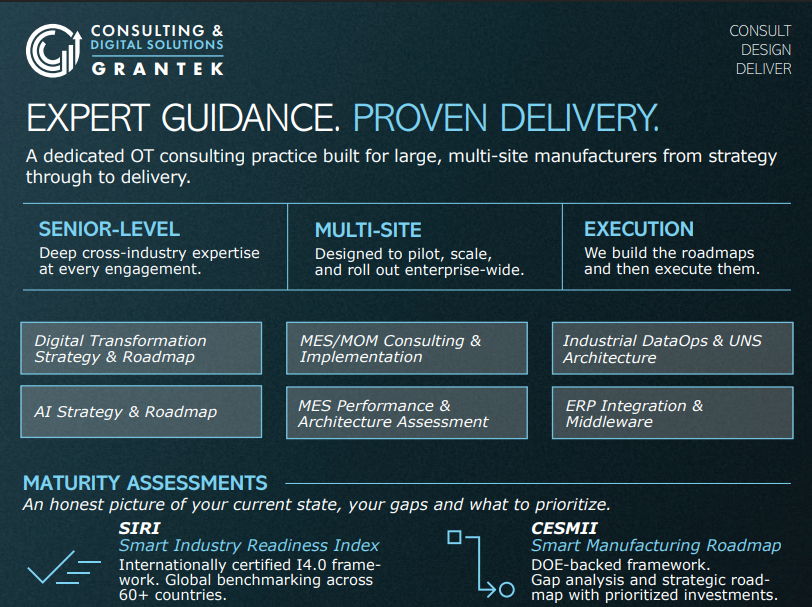
None of this means manufacturers should wait. It means the starting point for a serious AI initiative usually isn’t a model, it’s an honest look at data readiness, one or two well-scoped use cases, and a plan for how the organization will actually use what gets built. If you’re trying to figure out where your operation stands, or what the right first use case looks like, that’s a roadmap conversation. Grantek’s AI Navigator is built around exactly that. Everything above applies with an added layer of difficulty. In a validated environment, the questions aren’t just “does this work” but “can we prove it works, and who’s accountable when it doesn’t.” Alarm management, predictive maintenance, computer vision for inspection; these use cases are already live on plant floors in pharma and other regulated industries. The constraint isn’t the technology. It’s sequencing AI adoption in a way that respects validation and compliance requirements from the start, rather than retrofitting them after a pilot has already gained momentum. That’s the gap Grantek Consulting’s AI Navigator is built to close for regulated sites: a grounded evaluation of what’s viable in your environment, a sequenced roadmap that accounts for compliance from day one, and a model monitoring approach that catches performance drift before it becomes a deviation. Click here for more information.

What’s Actually Slowing Manufacturers Down?

Fragmented data

Years of production data spread across historians, MES, SCADA, and spreadsheets, with no consistent naming or context between them. AI can’t reason over data it can’t find or trust.

Legacy systems that weren’t built for this

Point-to-point integrations and on-prem systems never designed to feed a model, let alone feed it in real time.

Pilot fatigue

Teams that ran one or two AI pilots that showed promise, then stalled at the point where scaling required work nobody had scoped.

Workforce and trust

Operators and engineers are being asked to act on recommendations from a system they didn’t build and don’t fully understand. Adoption is usually about trust more than technical accuracy.

Governance and accountability

Who signs off when an AI recommendation is wrong? What’s the audit trail? In regulated environments, this isn’t optional.

Measuring the right thing

ROI models built around hard efficiency numbers can miss that adoption, not accuracy, is usually the real bottleneck.

AI in Manufacturing FAQ

Is AI actually working in manufacturing today, or is it still hype?

Both, depending on where you look. Narrow, well-scoped use cases including defect detection, predictive maintenance and demand forecasting are delivering real results at plants with clean data. Broad, ambitious AI transformations without a data foundation are where most of the disappointment comes from.

Do we need a data lake or Unified Namespace before we can do anything with AI?

Not necessarily before you start, but you’ll hit a ceiling fast without one. Most manufacturers can run a focused pilot on the data they already have. Scaling past that pilot is where data architecture becomes unavoidable.

Is generative AI or agentic AI the right place to start?

For most manufacturers, neither is the starting point. The starting point is the use case — a specific quality, throughput, or downtime problem worth solving. The right technology follows from that, not the other way around.

How do we know if we’re ready?

A readiness assessment across your data, systems, and organizational fundamentals is the fastest way to find out. That’s the first output of an AI Navigator engagement.

Grantek’s Consulting & Digital Solutions: Expert Guidance and Proven Results

FEATURED CASE STUDY

Grantek’s Consulting & Digital Solutions: Expert Guidance and Proven Results

Grantek’s Consulting & Digital Solutions Team a dedicated OT consulting practice built for large,...

READ MORE

Copyright ©2026 Grantek

CONTACT US NOW